
Introduction
A website is more than just an online catalog. It’s a place to engage, educate, and turn visitors into customers. It is the digital face of your business. It’s your 24/7 salesperson. It builds trust and generates leads, but simply having a website isn’t enough if people can’t find it; it won’t bring results. It is not just about beautifying your website; its main purpose is to make it easy for the user to understand. That’s the point where website marketing matters.
Website marketing is the process of promoting your website to attract visitors, generate leads, and convert them into loyal customers. Whether you run a small local shop or a large business, your website needs visibility to compete in today’s digital era.
What is Website Marketing?
Website marketing is all about the strategies and techniques used to increase traffic to your website and turn visitors into customers.
It’s not just about building a website. It’s about making sure people find it, trust it, and take action once they’re there.
Key goals of website marketing:
- Visibility: Visibility is all about ensuring your site appears in search results. If your website does not appear in search results, how will it generate leads?
- Engagement: it’s not about just scrolling your site. It’s about what users do on your site. Engagement means visitors are interested and taking actions that matter to you. It involves offering valuable content to keep them interested
- Conversions: Conversions are the actions users take on your website, like making a purchase, signing up, or contacting you, that help you achieve your business goals.
Example: Imagine a bakery in Kanpur that just launched a website. Website marketing would include making sure it ranks on Google when people search for “best bakery in Kanpur,” promoting it on social media, running ads, and adding blogs that attract food lovers.
Why is Website Marketing Important in 2025?
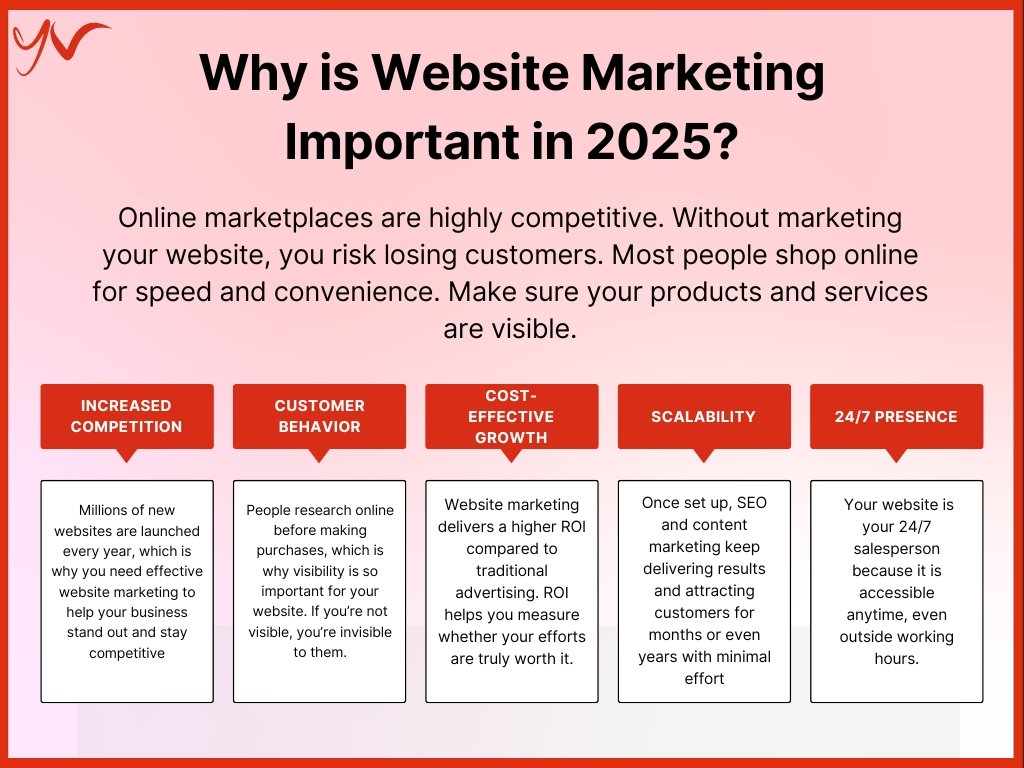
The online marketplace is far more competitive than the offline one. If you don’t market your website, you risk losing customers to competitors. Today, most people prefer shopping online because it’s faster and more convenient, which makes it essential to showcase your products and services online.
Here’s why website marketing matters today-
- Increased Competition – Millions of new websites are launched every year, which is why you need effective website marketing to help your business stand out and stay competitive. Only businesses with smart marketing succeed. Make sure your business is one of them.
- Customer Behavior –People research online before making purchases, which is why visibility is so important for your website. If you’re not visible, you’re invisible to them.
- Cost-Effective Growth – Website marketing delivers a higher ROI compared to traditional advertising. ROI helps you measure whether your efforts are truly worth it.
- Scalability- It means that once strategies like SEO and content marketing are set up, they can continue delivering results and attracting customers for months or even years with minimal extra effort.
- 24/7 Presence – Your website is your 24/7 salesperson because it is accessible anytime, even outside working hours. But just having a website isn’t enough; marketing ensures that people actually find and visit your site.
Step-by-Step Guide to Website Marketing
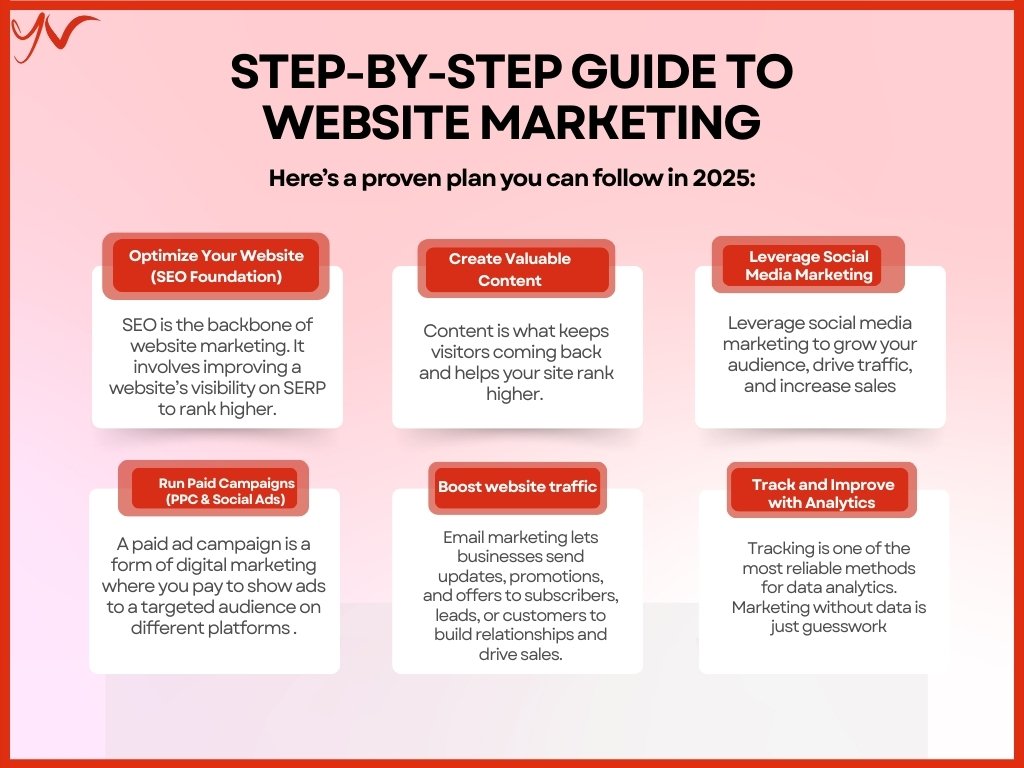
Here’s a proven plan you can follow in 2025:
1. Optimize Your Website (SEO Foundation)-
Search Engine Optimization (SEO) is the backbone of website marketing. It involves improving a website’s visibility on search engines like Google to rank higher in search results. Without SEO, your site won’t appear when people search for your products or services.
- Technical SEO– Make sure your website is free from crawl errors, broken links, and other technical issues so search engines can index your pages correctly.
- On-Page SEO – Optimize your webpages with proper headings, meta tags, and structure to make your content easy for search engines to understand.
- Off-Page SEO – Earning high-quality backlinks from trusted sites and promoting your content online to build authority for your website.
- Local SEO – Optimize your website for nearby searches to attract more local customers to your physical store or service area.
Some tips for doing SEO-
- Keyword Research – Find out what people are searching for and use those keywords naturally in your content.
- Create Quality Content – Write helpful, original, and in-depth content that solves users’ problems.
- Improve Website Speed – Ensure your site loads quickly because a fast-loading website ranks better and keeps users engaged.
- Make It Mobile-Friendly – Most people search on mobile, so your site must look good or supportive on all devices.
- Build Backlinks – Get links from other trusted websites to improve your website’s authority.
- Use Internal Linking – Link to other pages on your site to help search engines understand your structure easily.
- Optimize Images – Use descriptive file names, alt text, and compress images for faster loading.
- Track & Measure Data – Use tools like Google Analytics and Google Search Console to see what’s working.
- Keep Updating Content – Refresh old blogs and pages to stay relevant.
2. Create Valuable Content-
Content is what keeps visitors coming back and helps your site rank higher. By providing valuable content, you engage your audience and encourage them to return again and again.
How to provide Valuable Content–
- Write blogs, guides, and case studies that answer customer questions. Use different platforms to post your content.
- Use videos, infographics, and podcasts for better engagement.
- Focus on timeless content that stays relevant for years.
3. Leverage Social Media Marketing
Leverage social media marketing to grow your audience, drive traffic, and increase sales. Social media platforms are powerful tools for promoting your website and connecting with your audience. When done right, social media marketing complements your website strategy by ensuring your content reaches the right people at the right time.
Tips for Effective Social Media Marketing-
- Know Your Audience- Know who you are targeting, understand their interests, and identify which platforms they use most.
- Choose the Right Platforms- Focus on platforms where your audience is most active, like Instagram, LinkedIn, Facebook, etc.
- Post Consistently- Maintain a regular posting schedule to stay visible and build trust.
- Share Valuable Content- Post that content which is informational, educates, entertains, or solves problems, not just for promotions.
- Use attractive Visuals- Images, videos, and infographics that grab users’ attention and get higher engagement.
- Engage with Your Audience- Connect with your audience by replying to comments, answering messages, and encouraging conversations.
- Leverage Hashtags and Trends- Use relevant hashtags and trending topics to expand your reach.
- Run Targeted Ads- Run paid ad campaigns to reach specific audiences and drive traffic to your site.
- Track Performance- Monitor metrics like reach, engagement, clicks, and conversions to refine your strategy.
- Stay Consistent with Branding- Use the same tone, colors, and style across all platforms. Keep your messaging and visuals aligned with your brand identity.
4. Run Paid Campaigns (PPC & Social Ads)
A paid ad campaign is a form of digital marketing where you pay to show ads to a targeted audience on platforms like Google, Facebook, Instagram, LinkedIn, or YouTube. These campaigns are designed to increase traffic, generate leads, and boost sales. Paid ads bring instant traffic while SEO builds long-term growth.
Some tips-
- Use Google Ads to appear when people search for your services.
- Run Facebook, Instagram, or other platform ads targeting your ideal customers
- Try retargeting campaigns to bring back users who visited but didn’t convert.
5. Use Email Marketing
Email remains one of the most effective tools for website marketing. Email marketing is a form of digital marketing where businesses send emails to a list of people, like subscribers, leads, or customers, to share updates, promote products or services, and build relationships.
Some tips–
- Offer free downloads, discounts, or newsletters to collect email subscribers.
- Send personalized campaigns linking back to your website.
- Segment your audience into groups to send personalized content that engages and converts better.
6. Track and Improve with Analytics
Tracking is one of the most reliable methods for data analytics. Marketing without data is just guesswork. Without proper tracking, you can’t identify your mistakes or know where most of your leads are coming from.
Some tips-
- Use Google Analytics to track where your visitors come from.
- Check bounce rates, conversions, and top-performing pages.
- Adjust your strategies based on what works correctly.
Tip- If blogs bring more traffic than ads, invest more in content creation.
Website Marketing vs Web Marketing
Website marketing is one part of web marketing. All website marketing is web marketing, but not all web marketing is website marketing.
Although the terms sound similar, they are slightly different:
WEBSITE MARKETING-
- Promoting a specific website to drive traffic, generate leads, and boost sales.
- Focus mainly on SEO, blogging, website design improvements, landing pages, ads, and CRO (conversion rate optimization).
- Its scope is narrow and website-specific
- The goal is to bring people directly to your website and convert them into loyal customers
WEB MARKETING-
- Promoting your business across the web to build brand awareness, drive traffic, generate leads, and boost sales.
- Focuses on multiple channels like websites, social media, email marketing, online ads, influencer collaborations, and content marketing.
- Its scope is broad and multi-channel, covering all online engagement channels where your audience might interact.
- The goal is to reach people wherever they are online, guide them through the customer journey, and turn them into loyal customers.
Which digital marketing course in Kanpur to do for in-depth learning?
Your website has the potential to be your most powerful marketing tool, but only if you promote it effectively. Website marketing basically comes under the Digital Marketing course.If you are serious about building a career in digital marketing, choosing a clear and well-structured learning path is the first step toward success. YV Institute of Digital Marketing offers programs designed for both short-term and long-term goals.
Our curriculum includes certification courses with flexible options for online and offline classes, guided by experienced mentors. Courses range from 6 to 9 months, depending on the program you select. We focus on interest-based learning and provide a variety of options to suit every student. At YV Institute of Digital Marketing and Agency, our goal is to help you launch and grow a successful career in digital marketing.
FAQs About Website Marketing
Q1. Is website marketing a part of Digital marketing?
Yes, website marketing is a part of digital marketing. To do effective website marketing, you need to understand the broader principles of digital marketing.
Q2. Is website marketing necessary for small businesses?
Yes. It’s cost-effective and helps small businesses compete with larger brands.
Q3. How long does website marketing take to show results?
SEO and content may take 3–6 months, while PPC ads can bring instant traffic.
Q4. Can I do website marketing on my own?
Yes, but professional support accelerates growth and ensures better results.
Q5. What tools help in website marketing?
Google Analytics, SEMrush, Ahrefs, Mailchimp, Canva, and HubSpot are some popular tools.
Q6. How much does website marketing cost?
It depends on the strategy; SEO and content are long-term investments, while paid ads require ongoing budgets.